עברית
Motion
AccessibilityPrivacy
AboutIsrael

Idan Achrak

I'm Idan Achrak, a senior full-stack developer in Israel who builds whole systems and designs them, from the server to the last pixel.

At Merkaz Ta'az (IDF) I lead two teams, one of developers and one of ICT and infrastructure, and I led Ta'az's Hebrew digital platform from the brief to production, on one shared design system. I also built Launchpad, my deployment tool, and I'm the lead developer of Tovanto.

Also spelled Idan Ahrak or Idan Akhrak.

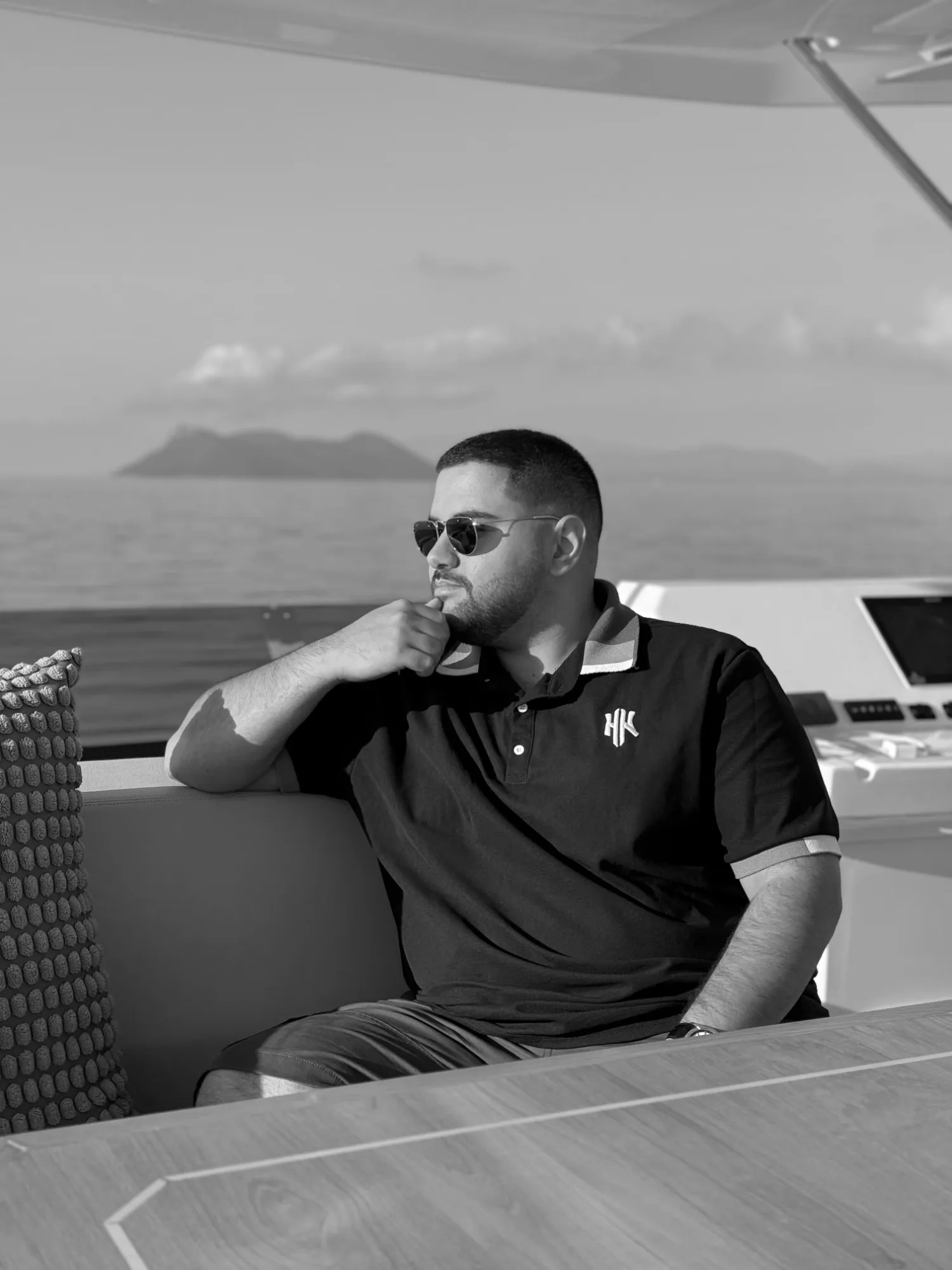
Idan Achrak on a boat, in black and white
NowSenior Full-Stack Developer & DevOps, Merkaz Ta'az (IDF)
AlsoPartner, lead developer and architect, Tovanto
Based inIsrael
LanguagesHebrew (native) · English (fluent)
01 / The path

From a 72-line ping script in 2022 to whole platforms in production.

  1. 2018 – present

    Freelance software engineer

    Since 2018 I have built custom web and mobile apps for business clients, including a customer-management system (CRM) for a business, along with automation in Python, Bash and PowerShell, Docker deployments and end-to-end IT solutions. I have also built websites in WordPress, with basic SEO. Outside client work, in 2023 I published Wicogen, a free Windows app that turns pictures into folder icons: my first app for the public, with six releases in seven weeks, an installer and a right-click menu.

  2. Feb 2022 – June 2023

    Software developer and IT Center Commander, Tikshuv AKA

    I joined the IDF in February 2022, and in April I started with a 72-line script that pinged network switches; two days later it had a full-screen map. It became Project P.I.N.G.E.R., my first complete product, and both its versions were used in service. I also built Hoger Scanner, a self-service ID-card kiosk first used at a conference in December 2022, and my own map-tiles tooling, and I served as IT Center Commander, leading a 9-person team.

  3. Oct 2023 – Sept 2025

    Platform engineer and software developer, Tikshuv AKA

    From October 2023 I served in active reserve duty through the war. Under wartime conditions I took the Hamal Monitoring App, a real-time app for ops rooms, from brief to production in 25 days, then grew it in eight releases into a monitoring app for many sites. I built and deployed MILESTONE, the project manager for the IT and infrastructure projects of the Personnel Directorate (eleven versions in ten months, shaped by its users' requests), built T100 for an event led by AKA in seven weeks, led the IT modernisation of the IDF's assessment center for colonels and engineered a secure digital platform for equipment sign-off. In 2025 I also published the first generation of Launchpad, my deployment tool, on GitHub. In mid-2025 I received an official Recognition for Contribution for my technological impact.

  4. Tikshuv AKA

    Team lead

    As a team lead I directed other developers' work. When the check-in kiosk moved to the web, a soldier on my team made the first attempt, which was not stable, and Noam Shadmi stabilised it; when the product was still weak we started over, Noam built v0.1 and helped shape the idea, and I redeveloped it into the current product. The Conference Clock went the same way: Noam built its first version at the end of 2024 and helped shape the idea, and I took it over and redeveloped it into the clock for AKA's conferences and study days.

  5. Sept 2025 – present

    Engineering manager: team lead at Merkaz Ta'az

    At the end of September 2025 I moved to Ta'az, part of the IDF, where I lead two teams: four developers, me included, and five people in ICT and infrastructure. I wrote the brief for the new Ta'az platform and led it end to end, writing most of the code: portal and content system, API services, search and single sign-on. It is built for 14,500+ users across all units. The first version of its portal was live on Ta'az's closed network in October 2025, three weeks after I joined, and in August 2026 Launchpad installed the platform on the production server. When a second developer, Mazal Avitbul, joined, I split the code for parallel work and reviewed and merged her work. I also look after the older HR systems, for consultants, contracts, workplace accidents, loans, pensions and more, and the servers they run on; many of them are now being brought together into one CRM-style app, still in development, that will join the platform. I handle support end to end, evaluated OpenShift as a container platform for the Ta'az platform and found it less suited to the need, take part in cross-team efficiency projects, and document the systems so the knowledge does not rest on me alone. In March 2026 I was awarded a Plaque of Appreciation for my contribution to the digital transformation. Alongside, I built TaazTV for Merkaz Ta'az and continued cross-unit projects with AKA: MobileSign (the 2026 version of the equipment sign-off platform), the Conference Clock and the Attendees Tracker.

  6. 2026 – present

    Partner and lead developer, Tovanto; lead developer for a transport company in Europe

    With my partner Itay Pizanty I run Tovanto, a Hebrew management system for catering businesses. Itay founded it and leads the product, sales and the SEO; I am the lead developer and architect, and I have owned every release to production since 8 October 2026. Tovanto has been live with its first customer in a closed beta since October 2026. Since September 2026 I have also led the rebuild of a complete business management platform for a transport company in Europe, built with Claude Code and covered by thousands of automated tests.

  7. 2024–2026

    AI-native engineering

    I moved from ChatGPT and Gemini as coding assistants, fed by a context-packing script I wrote, to directing Claude Code as an engineering agent in 2026, and then rolled Claude Code out as standard practice across my section: code generation, review, documentation and legacy reverse-engineering. I write the specs, plans and rules, keep tests and CI as gates, have AI review agents re-audit the work, and review and merge every change myself. That is how one developer shipped Launchpad's 86 commits on three working days, MobileSign's October version in seven and TaazTV in one.

02 / What I build

Different problems, one habit: I own the whole thing, from the data to the screen.

01

Internal products for real workflows

Tools built around the people who use them: event check-in and a conference clock, a project manager for my commanders, an equipment sign-out system, a work-tracking tool for an AKA-led event and a news board for Merkaz Ta'az.

02

Monitoring

Live status screens that raise the alarm by themselves: every network switch on a map of Israel, and every device in an ops room on its floor plan.

03

Web platforms

Hebrew web platforms with approvals, permissions, search and records that hold up: the Ta'az platform, MobileSign and MILESTONE.

04

Products for businesses

Business management systems. Tovanto is a system for catering businesses, in Hebrew. The transport platform runs a whole transport company in Europe from one engine.

05

Infrastructure and deployment

Launchpad turns one settings file into a working Windows or Linux server, even offline, and it installed the Ta'az production server; the Ta'az platform ships as one offline bundle.

06

Windows imaging and IT

One unattended Hebrew Windows image and a logged setup kit for every exam station at the IDF's assessment center for colonels, joined to the center's domain. Its confidential assessments for promotion and placement need stations that are identical, reliable and quick to restore.

03 / How I work

The rules I work by, and where you can see them.

  1. Product ownership

    I start from the problem and write it down: the Ta'az brief, MobileSign's blueprint and permission specification, Launchpad's seven-question settings file. Then I decide the product rules and answer for the result in production.

  2. Design is part of the build

    I fix the rules before the screens: one scale for spacing, type and colour, one shared component library, and a measurement of the result at the end. console-ui, my design system, writes those rules down as tokens for two design languages; the Ta'az platform runs on one design system, with a Showcase where every component runs on sample data; TaazTV's screen was checked by measurement; Spark Rework's dark theme was checked for contrast and moves no layout.

  3. Plan from scratch, rebuild when it pays

    I plan systems from a blank page and rebuild them when the foundations stop fitting: Pinger V2 from scratch, MILESTONE 2.0 with its data carried over, T100's data model rebuilt around teams, and the Ta'az code split into repositories and brought back into one workspace in a day.

  4. AI-native, human-owned

    I direct AI tools the way a lead directs a fast team: written specs and plans, rules kept in the repository, tests and CI as hard gates, AI review agents, and my own review before anything merges.

  5. Hebrew first, right to left

    In products for Hebrew-speaking users, Hebrew comes first: right-to-left layouts, search that understands Hebrew prefixes and acronyms, a calendar of every community's holidays, Excel imports that recognise Hebrew headers.

  6. Built for closed networks

    Much of my work runs where there is no internet: offline bundles and installers (the Ta'az platform, Launchpad, MILESTONE, T100), a board that needs no outside services (TaazTV) and stations installed from one USB stick (the assessment center).

  7. Fast, versioned delivery

    I ship in small, dated releases and listen between them: the Hamal app had 8 releases in 14 weeks, the kiosk 6 versions in 7 months, MILESTONE 11 versions in 10 months and T100 3 versions in 7 weeks.

  8. Credit where it is due

    I name the people I built with: Mazal Avitbul built the Ta'az notification service; Noam Shadmi set up the assessment center's servers with me, built the early versions of the Conference Clock and of the new Attendees Tracker and helped shape both ideas. Itay Pizanty founded Tovanto and leads its product, sales and SEO.

  9. Writing for every audience

    I document for the people who read it: a Hebrew overview for management, a runbook for IT operators, design specs for developers, a Hebrew user manual for event staff and an operator checklist for the clock.

04 / Strengths, with proof

Each claim comes with the project that proves it.

Designs what he builds

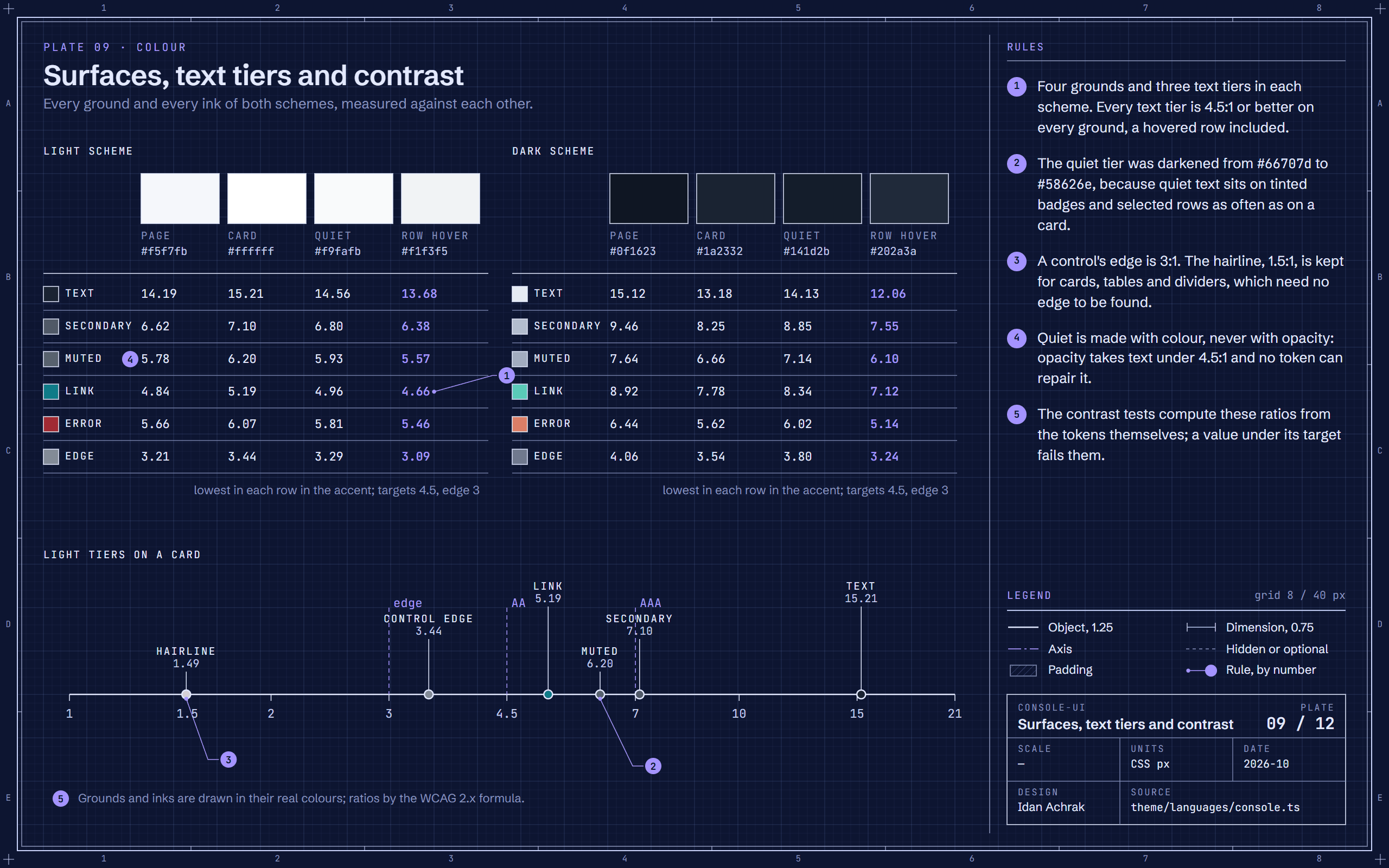
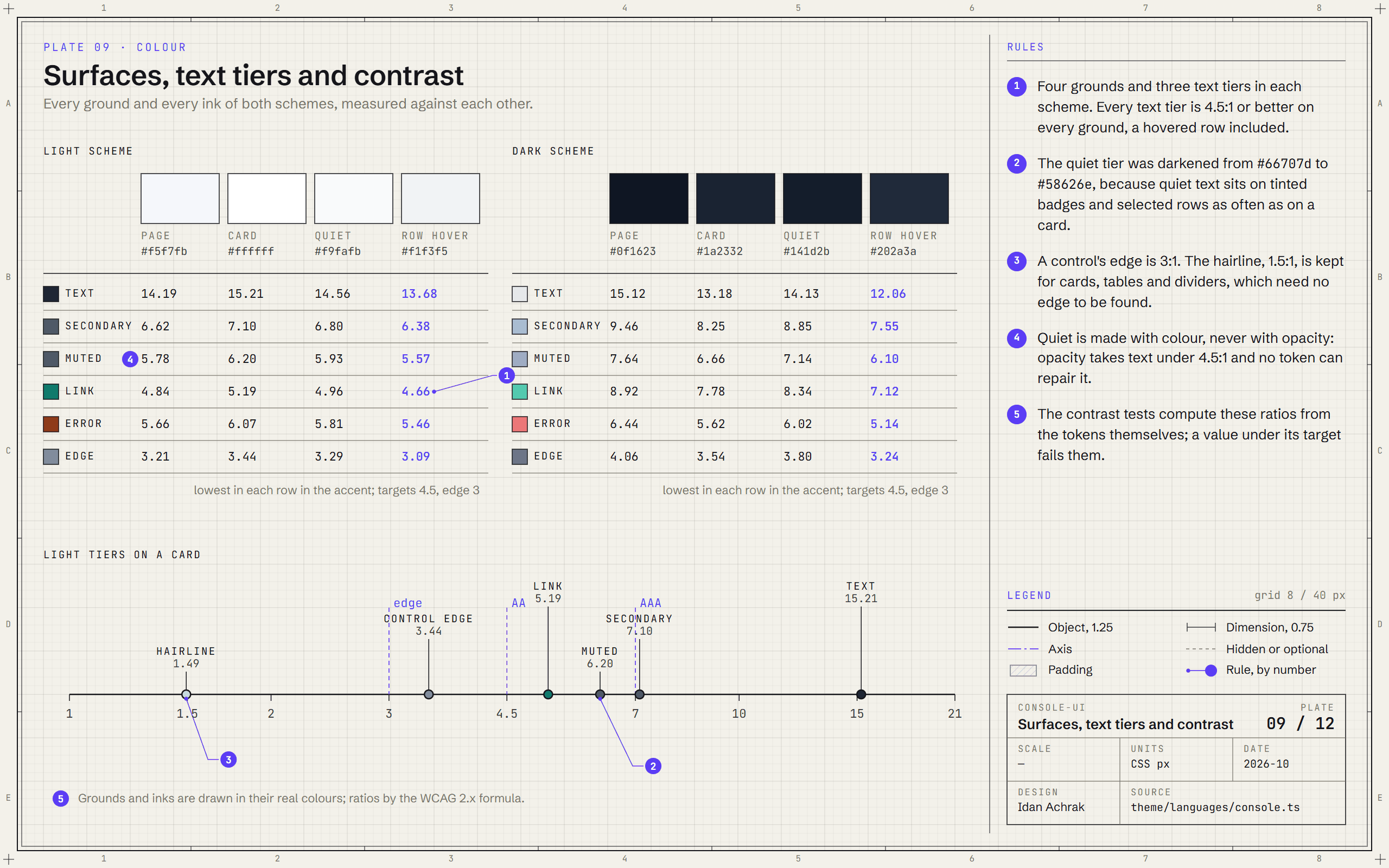
console-ui, my own design system: one component skeleton dressed by two design languages, each in light and dark and held to WCAG AA contrast, with its radius, spacing, type and shadow scales written down as tokens, right to left by default, and a showcase where every component runs live. Also the Ta'az design system with its Showcase site, MobileSign's 42 guided tours written for five kinds of user, and TaazTV's screen checked by measurement: 254 QR codes read back and its scrolling measured frame by frame.

Blueprint of console-ui's colour tokens: the grounds of the light and dark schemes, a matrix of contrast ratios for every text tier, and the light tiers on one contrast scale.Blueprint of console-ui's colour tokens: the grounds of the light and dark schemes, a matrix of contrast ratios for every text tier, and the light tiers on one contrast scale.
Plate 09Surfaces, text tiers and contrastEvery text tier is 4.5:1 or better on every ground, a hovered row included, and every control edge is 3:1: the ratios are computed from the tokens.
02

Takes a product from a brief to production

Ta'az platform: first version live in October 2025, three weeks after I joined, production server installed in August 2026, 430 of its 452 commits mine, built for 14,500+ users. Hamal app: brief to production in 25 days, in wartime.

03

Ships fast without losing control

TaazTV's working product in one day; Launchpad generation 2 in 86 commits on three working days with 310 tests; MobileSign's October version, 141 commits in seven working days, with 2,798 tests.

04

Turns requests into releases

MILESTONE's eleven versions were shaped by the requests of my commanders and other units; a Ta'az management request became a setting they control, in one day.

05

Builds for the real environment

Closed networks with no internet, Windows and Linux servers, exam stations that must be identical: offline bundles, a deployment engine and one Windows image.

06

Thinks in data and rules

MobileSign's six two-sided workflows and a history that is only ever added to; MILESTONE's 16-table model with migrations that carried the data; T100's three-level plan shared between teams.

07

Quality by evidence

Tests and CI on every change, adversarial AI reviews that caught real bugs, and measurement where tests are not enough: 254 QR codes read back by an independent decoder.

08

Leads and credits a team

Leads two teams at Merkaz Ta'az: four developers, him included, and five people in ICT and infrastructure; earlier IT Center Commander of a 9-person team, and team lead on the move of check-in to the web; onboarded a second developer and reviewed and merged her work; credits Noam Shadmi and Mazal Avitbul for their parts.

09

Grows tools into products

Pinger went from a 72-line script to two versions used in service; the Hamal app went from one ops room to a monitoring app for many sites in about three months.

05 / Skills

What I can do, and where I did it.

Product and leadership

Web development: front end

Back end, APIs and data

Desktop apps: Python and pygame

Infrastructure, deployment and DevOps

Windows imaging and IT

Data and integration

UX and Hebrew right to left

AI-assisted engineering

06 / Technology

112 technologies I have shipped with, in 9 areas.

Languages

  • Python
  • TypeScript
  • JavaScript
  • CSS
  • HTML
  • PowerShell
  • Windows Batch
  • Windows Batch and Bash

Front end

  • React
  • Vite
  • Mantine
  • Tailwind CSS
  • Astro
  • Chart.js
  • DataTables
  • Design tokens
  • Material UI (MUI)
  • React Router
  • Bootstrap
  • BroadcastChannel
  • dnd-kit
  • Flatpickr
  • FullCalendar
  • GridStack
  • Immer
  • Intl (Hebrew calendar)
  • Jinja2
  • jQuery
  • localStorage
  • Moment.js
  • qrcode-generator
  • React Hook Form
  • SVG
  • TinyMCE
  • Zod
  • Zustand

Back end and APIs

  • Flask
  • Authlib (OpenID Connect)
  • Flask-Login
  • Flask-WTF
  • Pydantic
  • requests
  • Waitress
  • Cheroot
  • Django
  • Django REST Framework
  • FastAPI
  • FFmpeg
  • Gunicorn
  • JWT
  • Meilisearch
  • Open-Meteo
  • PyCasbin
  • Python http.server
  • Server-Sent Events
  • Spire.Office
  • Supabase
  • Tesseract OCR
  • Uvicorn

Databases and data

  • SQLAlchemy
  • SQLite
  • Alembic
  • pandas
  • PostgreSQL
  • Excel files
  • openpyxl
  • JSON Schema
  • matplotlib
  • Microsoft SQL Server

Desktop apps (Python)

  • Pillow
  • pygame
  • PyInstaller
  • Python threading
  • CustomTkinter
  • tkinter
  • netifaces
  • OpenCV
  • pygame_gui
  • Windows networking (ping, gateways)

Infrastructure, deployment and CI

  • pnpm
  • GitHub Actions
  • nginx
  • NSSM (Windows services)
  • Cloudflare Workers
  • Docker / Podman compose
  • Launchpad (my own deployment tool)
  • Let's Encrypt / Certbot
  • OpenSSL
  • systemd

Testing and code quality

  • pytest
  • ESLint
  • Vitest
  • Headless Chrome
  • mypy
  • Playwright
  • ruff
  • WCAG contrast checks

Windows imaging and IT

  • Active Directory (domain join)
  • autounattend.xml answer files
  • HackBGRT (UEFI boot logo)
  • Microsoft Exchange (mail server)
  • Office Deployment Tool
  • Office LTSC 2021 (offline)
  • Sysprep and image capture
  • VirtualBox (server host)
  • Windows 10 Pro (Hebrew)
  • Windows ADK (OSCDIMG)
  • Windows Server 2022 (domain controller and shared drives)

AI tools

  • Claude Code
  • Gemini
  • ChatGPT
  • Claude Design
07 / Year by year

What changed each year, and the releases that mark it.

2022

Soldier-developer: first complete products

I joined the IDF in February 2022. At Tikshuv AKA I built, packaged and supported my first tools myself, learned to rewrite code once it became hard to change, and served as IT Center Commander of a 9-person team.

Month by month (5)
  • AprilProject P.I.N.G.E.R. starts as a 72-line ping script; two days later it has a full-screen map. Project P.I.N.G.E.R.
  • JulyMap Tiles Downloader (July–August): my own downloader and stitcher for a 1.1-gigapixel offline map. Map Tiles Downloader
  • SeptemberPinger V1 is released as a single Windows program anyone can run, and the network team uses it in service. Project P.I.N.G.E.R.
  • NovemberHoger Scanner kiosk 1.0: swipe or scan the military ID card, get a greeting, entry and exit times recorded. AKA Attendees Tracker
  • DecemberThe kiosk checks in the guests of its first conference. AKA Attendees Tracker

2023

From tools to products

In September, my first app for the public, released six times in seven weeks. From October, in active reserve duty through the war, as a platform engineer: a war-room app in production 25 days after the brief, installers, editions, licensing and a fast, versioned release cadence; reusable widget code of my own.

Month by month (6)
  • JanuaryKiosk versions 2.0 to 2.6 (to June): live counters, a save after every scan, Excel in and out. With version 1.0, six versions in seven months. AKA Attendees Tracker
  • JunePinger V2 rewritten from scratch on reusable widget classes I prototyped first, and complete in July; like V1, it is used in service. Project P.I.N.G.E.R.
  • SeptemberWicogen, a free Windows app that turns any picture into a folder icon, published on my own: six releases in seven weeks, with an installer and a right-click menu. My first app for the public. Wicogen
  • OctoberThe first version of the Hamal Monitoring App, built under wartime conditions for a single ops room and in production 25 days after the brief: floor plans, live checks, alarms, device records and an installer. Hamal Monitoring App
  • NovemberA tree of regions, bases, ops rooms and cells; two editions and licences issued with my own Licensing Tool. Hamal Monitoring App
  • DecemberBoth editions merged into one app; the licence decides which one runs. Hamal Monitoring App

2024

From desktop to web

Flask, SQL databases and multi-user web systems; AI tools join my work: Gemini and ChatGPT for planning and coding.

Month by month (5)
  • FebruaryHamal App 2.4.2: eight releases in fourteen weeks. Later in the year I started a browser version as the next step. Hamal Monitoring App
  • AugustThe assessment center's IT modernisation begins: a first plan for a custom Hebrew image, made with Gemini and ChatGPT. Assessment Center IT Modernisation
  • NovemberMILESTONE starts as a local app on one computer, built with ChatGPT and Gemini as coding assistants. MILESTONE
  • NovemberChessArena: I redevelop a friend's Django final project (accounts, sign-in, pages). ChessArena
  • DecemberMILESTONE becomes a multi-user web system with sign-in and first scripts to install it without internet. MILESTONE

2025

Team lead, web systems, infrastructure, and the move to Ta'az

Team lead at Tikshuv AKA, systems shaped by their users, my own deployment tool and an IT modernisation; then, at Ta'az, two teams to lead, developers and ICT, and a platform to own from its first brief.

Month by month (12)
  • JanuaryMILESTONE gets its approval stages, one-click Word reports and its name. MILESTONE
  • FebruaryT100 for an event led by AKA (to March): three versions in seven weeks. T100
  • AprilLaunchpad generation 1 published on GitHub; in July it is named Launchpad, with four guides and an MIT licence. Launchpad
  • MayMILESTONE 2.0: rebuilt from the ground up, with the existing data carried over. MILESTONE
  • JuneThe unified Windows image is built on 4 June, and the first stations are installed from it on 5 June. Assessment Center IT Modernisation
  • AugustI take over the Conference Clock, first built by Noam Shadmi at the end of 2024, and redevelop it with Gemini and ChatGPT. AKA Conference Clock
  • AugustMILESTONE's final version delivers my commanders' and the units' requests: 11 versions in 10 months. MILESTONE
  • SeptemberNexusPlatform (to February 2026): a startup attempt that stayed at the prototype stage, spec-driven with Gemini. NexusPlatform
  • SeptemberI move to Ta'az as engineering manager at Merkaz Ta'az, leading two teams: four developers, and five people in ICT and infrastructure. Ta'az Digital Platform
  • OctoberI write the bilingual brief of the new Ta'az platform and start version 1, built with Gemini. Ta'az Digital Platform
  • DecemberTa'az: a shared component library, a search engine and a security design for the platform's servers. Ta'az Digital Platform
  • DecemberA written spec for Launchpad's next generation: closed networks, several servers, premade certificates. Launchpad

2026

Engineering manager at Ta'az, AI-native engineering, and products for businesses

A five-service platform in production, built for more than 14,500 users, a teammate onboarded and reviewed, and Claude Code directed with specs, plans, tests and reviews on most of my 2026 projects, then rolled out across my section; and outside the IDF, Tovanto with my partner, live with its first customer in a closed beta, and the rebuild of a complete platform for a transport company in Europe.

Month by month (18)
  • JanuaryMobileSign, a cross-unit project with AKA: the blueprint for AI code generation and the first complete server. MobileSign
  • MarchTa'az platform version 2: the code split for teamwork; Mazal Avitbul joins and builds the notification service. Ta'az Digital Platform
  • AprilThe Ta'az portal is live on the closed network; I write a Hebrew overview of the platform for management. Ta'az Digital Platform
  • MayConference Clock 4.0.1, with an operator guide, a pre-event checklist and architecture docs. AKA Conference Clock
  • MayAttendees Tracker 1.0.0, redeveloped with Claude Code: 20 commits in under 20 hours. AKA Attendees Tracker
  • MayWith my partner Itay Pizanty I start working on Tovanto, a Hebrew management system for catering businesses, as lead developer and architect. Tovanto
  • JuneTa'az version 3: every part in one workspace in one day; Claude Code from written specs, plans and tests. Ta'az Digital Platform
  • JuneLaunchpad generation 2 rebuilt with Claude Code as one tested Python engine (22 June – 1 July). Launchpad
  • JulyLaunchpad ready for production after five hardening phases re-audited by AI agents, with 310 tests; the Ta'az platform switches to it. Launchpad
  • Julyconsole-ui, my own design system: one component library for operator consoles, dressed by two design languages in light and dark, right to left by default, with a live showcase of every component. console-ui
  • AugustA management request delivered in one day; Launchpad installs the Ta'az production server. Ta'az Digital Platform
  • AugustMobileSign hardened with Claude Code: CI, a read-only role, and a full review that fixed 24 findings. MobileSign
  • SeptemberSpark Rework: a full dark theme in one night, by directing Claude Code agents. Spark Rework
  • SeptemberTaazTV for Merkaz Ta'az: designed in Claude Design and built in one day with Claude Code. TaazTV
  • SeptemberI start leading the rebuild of a complete business management platform for a transport company in Europe, with Claude Code. Business platform for a transport company in Europe
  • OctoberMobileSign's October version: 141 commits in seven working days, 2,798 automated tests; the 2026 version rolls out, taking over the previous version's data. MobileSign
  • OctoberTovanto goes live with its first customer in a closed beta, and from 8 October every release to production is mine. Tovanto
  • OctoberThe transport platform's engine is built and tested, with more than 19,000 automated tests, and ready to be connected; the office screens come next. Business platform for a transport company in Europe
08 / Education and languages

Education and languages

Education and certifications

  • IDF: PowerShell Development (2023) and Network Administrator (2022)
  • Microsoft Azure: AZ-500 Security Engineer and AZ-104 Administrator (2021)
  • Ben-Gurion High School: diploma in physics and computer science, with highest honours (2020)

Languages

  • Hebrew (native)
  • English (fluent)
09 / Questions and answers39

The questions I am asked most, answered in plain words.

Who are you, in one sentence?

I'm Idan Achrak, a senior full-stack developer in Israel who builds whole systems and designs them, from the server to the last pixel.

Where have you worked?

I have worked as a freelance software engineer since 2018, building web and mobile apps and IT automation for business clients. I joined the IDF in February 2022 at Tikshuv AKA, the C4I and digital branch of the IDF Personnel Directorate: first as a software developer who also served as IT Center Commander of a 9-person team, then, from October 2023 to September 2025, in active reserve duty through the war, as a platform engineer and software developer. In September 2025 I moved to Ta'az, the IDF Civilian Employees Employment Center, as engineering manager at Merkaz Ta'az, where I lead two teams, lead the new Ta'az platform and continue cross-unit projects with AKA.

What does your role at Ta'az cover?

I lead two teams at Merkaz Ta'az (four developers, me included, and five people in ICT and infrastructure), and the work runs along three lines at once. The new Ta'az platform, which I lead and wrote most of. The older HR systems, for consultants, contracts, workplace accidents, loans, pensions and more: keeping them running, handling faults and permissions, and preparing their move into one CRM-style app, still in development, that will join the platform. And the ground under both: the servers, support end to end from a bug in the code to a hardware fault, and the team's day-to-day work. I evaluated OpenShift as a container platform for the Ta'az platform and found it less suited to the need, and because so much of the technical knowledge sits with me, I document the systems so the organisation does not depend on one person.

Which project represents you best today?

The Ta'az Digital Platform. I wrote its brief, designed the architecture, wrote 430 of its 452 commits, onboarded and reviewed a second developer, and took it to production on a closed network, where it is built for 14,500+ users across all units. It shows product ownership, architecture, teamwork and AI-assisted engineering in one project.

What exactly is the Ta'az Digital Platform?

A Hebrew self-service portal where HR staff, commanders and employees find Ta'az's official information, with a content system in which editors write, publishers approve and managers arrange the site without code. Around it: single sign-on, a secure file and media service, one shared design system, search that understands Hebrew, a multi-faith holiday calendar and an offline installation for the closed network. It is built for 14,500+ users across all units, and the older HR systems are next: they are being brought together into one CRM-style app that will join it.

Do you use AI tools?

Yes, openly, and I count it as a core skill. Before 2026 I worked with ChatGPT and Gemini; in 2026 I build mostly with Claude Code, Anthropic's AI coding agent, and I rolled it out as standard practice across my section. I write the specs and plans, keep rules in the repository, make tests and CI hard gates, have AI review agents re-audit the work, and review and merge every change myself. The decisions and the result are mine.

Which AI tools have you used, and where?

Claude Code: the Ta'az platform from version 3, Launchpad generation 2, MobileSign, the Attendees Tracker 1.0.0, TaazTV, Spark Rework, Tovanto and the transport platform, and I rolled it out across my section. Gemini: the Ta'az platform's versions 1 and 2, the Conference Clock, the assessment center, MILESTONE, T100, NexusPlatform and a rules file in Launchpad generation 1. ChatGPT: the Conference Clock, the assessment center, MILESTONE and T100. Claude Design: TaazTV's visual design, from my own sketch and prototype. Google Antigravity: the first version of a client's website. My CV also lists Codex.

If AI writes code, what is your part?

Everything that decides the outcome: the problem, the requirements and the design, the product rules, the plan, the tests each change must pass, the review of every change and the responsibility in production. In MobileSign more than twenty commit messages quote my rulings, and in the Attendees Tracker I had a change undone because it touched a screen I had already approved.

How fast can you deliver?

Some examples: the Hamal app, from brief to production in 25 days under wartime conditions; TaazTV's working product in one day; Launchpad generation 2's 86 commits on three working days, with 310 tests; MobileSign's October version, 141 commits in seven working days, with 2,798 tests; and a Ta'az management request, from spec to finished feature in one working day.

Have you led a team?

Yes. Today I lead two teams at Merkaz Ta'az: four developers, me included, and five people in ICT and infrastructure. I set the work, mentor the team and review the code. On the platform I split the code so a second developer could work in parallel, set the structure she built on, and reviewed and merged her work. Earlier, at Tikshuv AKA, I served as IT Center Commander of a 9-person team, and as a team lead I directed other developers: when the attendance tracker moved to the web, a soldier on my team made the first attempt, which was not stable; Noam Shadmi stabilised it, and when the product was still weak we started over: Noam built v0.1 of the new system, and I redeveloped it into release 1.0.0.

Who did you build with?

Mazal Avitbul built the Ta'az platform's notification service and its local development setup. Noam Shadmi set up the assessment center's servers with me: the domain controller, the shared drives and the Exchange mail server. He also built the first version of the Conference Clock at the end of 2024 and v0.1 of the new Attendees Tracker, and helped shape both ideas up to just before the MVP; I then redeveloped each into the current product. Tovanto I run with my partner Itay Pizanty, who founded it and leads the product, sales and the SEO. Most of my other projects I built on my own.

Do you have DevOps and infrastructure experience?

Yes. I built Launchpad, which sets up a Windows or Linux server from one settings file: it installs the tools, runs each app as a service behind nginx, handles HTTPS certificates, checks every deploy and puts the previous version back if an app does not answer. Its second generation installed the Ta'az production server: five services and three HTTPS addresses from an offline bundle. At Ta'az I also own the servers, and I evaluated OpenShift as a container platform for the Ta'az platform and found it less suited to the need. I run containers with Podman on RHEL 9 Linux servers; for years an always-free Oracle Cloud server hosted my apps and portfolio, and today almost all my deployments run on Cloudflare. I have used GitOps in real work, on Tovanto and on the platform I am rebuilding for a transport company in Europe, and I have also learned Kubernetes, Vercel and Railway. At the assessment center Noam Shadmi and I set up a domain controller, shared drives and an Exchange mail server.

Can you work on closed networks with no internet?

That is where most of my work runs. The Ta'az platform installs from one offline bundle; Launchpad brings its tools and Python packages from a local bundle; MILESTONE and T100 ship with their own offline installers; TaazTV needs no outside services; and the assessment center stations install from one USB stick.

What is your front-end stack?

React and TypeScript with Vite, styled with Material UI (the Ta'az platform, MobileSign) or Tailwind CSS (the Conference Clock, the Attendees Tracker). Plain JavaScript, HTML and CSS when a framework is not needed: MILESTONE (on a component library of my own), T100 and TaazTV.

And the back end?

Python: Flask with SQLAlchemy (the Ta'az platform, MobileSign, MILESTONE, T100), with Alembic migrations where the data had to move to a new structure (the Ta'az platform, MobileSign, MILESTONE); FastAPI with Server-Sent Events (the Attendees Tracker); and Django (ChessArena). Microsoft SQL Server in production on the Ta'az platform, SQLite in most of the others, and Meilisearch for Hebrew search.

How do you test?

With automated tests and CI as gates, and with measurement where tests are not enough. MobileSign runs 1,610 server tests and 1,188 interface tests on every push; Launchpad has 310 tests and a CI pipeline that installs nginx, systemd and NSSM for real; and in TaazTV all 254 QR test codes were read back by an independent decoder.

Have you built desktop applications?

Yes: full-screen Windows apps in Python and pygame, on widget code of my own. Project P.I.N.G.E.R. monitors network switches, the Hamal Monitoring App monitors ops-room devices and ships with an installer, two editions and licensing, and the Hoger Scanner kiosk checks guests in with a barcode scanner and a card reader.

What did you do at the IDF's assessment center for colonels?

I led its IT modernisation. The center assesses lieutenant-colonels for promotion to colonel and for placement, so every station must be identical, reliable and quick to restore. On the station side I planned, tested and built one Hebrew Windows 10 image with Office, installed hands-off from one USB stick, plus a logged setup kit for the per-machine steps, including a one-step join to the center's domain; as the common setup moved into the image, the kit shrank from 24 actions to 9. Noam Shadmi and I set up the server side together: the domain controller, the shared drives and the Exchange mail server. I planned with Gemini and ChatGPT and tested every step on real laptops.

How do you handle requests from users and management?

I turn them into releases, and where I can into settings they control themselves. MILESTONE's eleven versions were shaped by the feature and fix requests of my commanders and of other units that used it. On the Ta'az platform, management asked to hide one holiday from the calendar; within a day it became a setting management controls itself.

Was your work used for real?

Yes. The Ta'az platform is built for more than 14,500 users across all units: the first version of its portal was live on Ta'az's closed network in October 2025, three weeks after I joined, and Launchpad installed its production server in August 2026. The Hamal app went from brief to production in 25 days. The network team used both versions of Project P.I.N.G.E.R. in service, the Hoger Scanner kiosk was first used at a conference in December 2022, and MILESTONE was used by my commanders and by other units. MobileSign's 2026 version is rolling out now, taking over the previous version's data. 42 people wrote and approved the portal's content.

What did you build for events?

Three tools. The AKA Conference Clock puts a whole conference day on the hall's screen and re-times it in one click when a talk runs late. The AKA Attendees Tracker checks guests in and out with a scan, from any computer, tablet or phone on the event network. T100 was built for an event led by AKA: teams track their work toward the goals set by the head of AKA, and a presentation mode turns the progress into slides for the event.

What is MobileSign?

A secure digital platform for logistics and equipment sign-off that replaces paper forms. Every unit runs its own digital warehouse, equipment moves only through six two-sided approve-and-sign workflows, the receiver ticks each item that actually arrived, and every hand-over is kept in a history no one can change, with a signed PDF document. I built the 2026 version on my own with Claude Code, with 2,798 automated tests; it is rolling out now, taking over the previous version's data: hundreds of devices and hundreds of leases.

What is the Hamal Monitoring App?

A full-screen Windows app that shows IT staff every device in an operations room (a hamal) on its floor plan, checks each one continuously and sounds an alarm the moment one stops responding. I built it under wartime conditions: in October 2023 the first release, for a single hamal, went from brief to production in 25 days, and over eight releases it grew into a multi-site product with regions, bases and ops rooms, two editions, an installer and licences.

What does P.I.N.G.E.R. stand for?

Nothing: it is not an acronym, just a name. Project P.I.N.G.E.R. is a full-screen map that checks every switch on a dedicated network once a minute and sounds an alarm the moment one drops; both its versions were used in service.

What is TaazTV?

A digital news and notice board I built for Merkaz Ta'az, to be shown on screens around the unit: news, notices, today's schedule and emergency numbers on one screen, kept up to date from a simple Hebrew control panel where staff type straight onto the cards. It runs offline on an ordinary computer, and I built the working product in one day with Claude Design and Claude Code.

How do you work with Hebrew and right to left?

Hebrew is my default, not an afterthought. My interfaces for Hebrew-speaking users are right to left; the Ta'az search finds Hebrew words with prefixes attached and acronyms with or without quote marks; its calendar holds about 2,300 Jewish, Christian, Muslim, Druze and national holidays; the Attendees Tracker recognises Hebrew Excel headers; and Pinger has its own Hebrew text input.

Do you rewrite things? When?

When the foundations stop fitting the need, and I plan the move. Pinger V2 was rewritten from scratch, and like V1 it was used in service. MILESTONE 2.0 was rebuilt with the existing data carried over by migrations. In T100 I rebuilt the data model around teams between the first and second versions. On the Ta'az platform I wrote down the cost before splitting the code into repositories, and when that cost appeared I brought it back into one workspace in a day, with all history kept.

How did you grow as a developer?

From a 72-line ping script in 2022, to desktop apps with installers and editions in 2023, to multi-user web systems and infrastructure in 2024–2025, to owning a five-service platform in production at Ta'az in 2025–2026, built with AI agents under my direction, while leading two teams.

Do you have personal or freelance projects?

Yes. With my partner Itay Pizanty I run Tovanto, a Hebrew management system for catering businesses. I also lead the rebuild of a complete business management platform for a transport company in Europe. I have worked as a freelance software engineer since 2018, building web and mobile apps and IT automation for business clients. Launchpad began as my own tool for hosting my web apps. Spark Rework is a full dark theme for a trading platform, made in one night by directing Claude Code agents. NexusPlatform was a startup attempt that stayed at the prototype stage. Map Tiles Downloader is my own offline-map tooling, and I redeveloped ChessArena to help a friend with his final project.

What is Tovanto?

A Hebrew management system for catering businesses, which I run with my partner Itay Pizanty: he founded it and leads the product, sales and the SEO, and I am the lead developer and architect. It keeps a caterer's leads, quotes built on real dish costs, events, supplier orders, crew and profitability in one place, at the desk and on a phone. It has been live with its first customer in a closed beta since October 2026; see tovanto.com.

What did you build for the transport company in Europe?

I lead the rebuild of a complete business platform for a transport company in Europe that drives travellers to and from airports, as lead developer and system architect. One engine runs bookings and pricing, payments and refunds, dispatch, partners and subcontractors, flights, messages and the back office. It is built with Claude Code and passes more than 19,000 automated tests: built, tested and ready to be connected.

Can I see the code?

The first generation of Launchpad, nginx-server-deployment, is public on GitHub under the MIT licence. So is Wicogen, the Windows folder-icon app I published in 2023, under the Mozilla Public License 2.0. The other projects live in private repositories of the organisations they were built for or in my private archives, so this portfolio shows them through screenshots, demo videos and detailed write-ups. Tovanto and the transport platform are private business code; tovanto.com is public.

Is the data in the screenshots real?

No. The screenshots and videos of the military projects show mock or demo data, captured from local runs or from my own recordings.

How do you document your work?

For whoever reads it: on the Ta'az platform a bilingual brief, a Hebrew overview for management, an operator runbook for the IT staff who run its servers and dated design specs for developers; in MobileSign a 1,642-line system description kept in step with the code; a Hebrew user manual for the Attendees Tracker; and an operator guide with a pre-event checklist for the Conference Clock.

How do you think about security?

As part of the design. On the Ta'az platform: single sign-on, role-based permissions down to folder level, expiring download links, audit logs and a segmented three-zone server design. In MobileSign: a permission check on every action and a history that is only ever added to. At the assessment center: exam-day protections built into every station.

How many people used your systems?

The Ta'az platform is built for 14,500+ users across all units, and its portal had more than 800 unique visitors a month. MobileSign, both of whose versions I built, has tracked more than 800 items and over 400 signed hand-overs, and its 2026 version is rolling out now with all of that data. The Conference Clock timed talks at more than 25 events, and the Attendees Tracker checked in thousands of people at over 90 events. MILESTONE tracked 353 projects, and in October 2026 112 of them were still active in it. The Hamal app was installed on 4 stations. Wicogen was downloaded 1,000+ times.

What certifications and education do you have?

From the IDF: PowerShell Development (2023) and Network Administrator (2022). From Microsoft: Azure AZ-500 Security Engineer and AZ-104 Administrator (2021). And a Ben-Gurion High School diploma in physics and computer science, with highest honours (2020). I speak Hebrew natively and English fluently.

What recognition have you received?

An official Recognition for Contribution from Tikshuv AKA in mid-2025, for my technological impact as a platform engineer there, and a Plaque of Appreciation at Ta'az in March 2026, for my contribution to its internal digital transformation.

How can I contact you?

Through my website, idanach.com, on LinkedIn (linkedin.com/in/idanach) or on GitHub (github.com/idanach).
10 / About this site
Drawn from photo 01, one dot per cell. Hover to light it up.

About this site

What I decided and made: the art direction, the paper and night looks, the right-to-left mirroring of every page, the three motion tiers, and the rule that every image and clip comes from my own projects. The signature motion, a 3D orbit of tiles around the title and letters that fly into the logo, takes its cue from getartcraft.com. I built the site with Claude Code, under my direction.

Astro · static HTML in English and Hebrew · Schibsted Grotesk, Instrument Serif, Heebo and Gveret Levin · GSAP and Lenis, only where they run · no cookies

Let's build something that lasts.

Chapters